Why the Pictures Are Stacked to the Ceiling
What a salon hang is doing
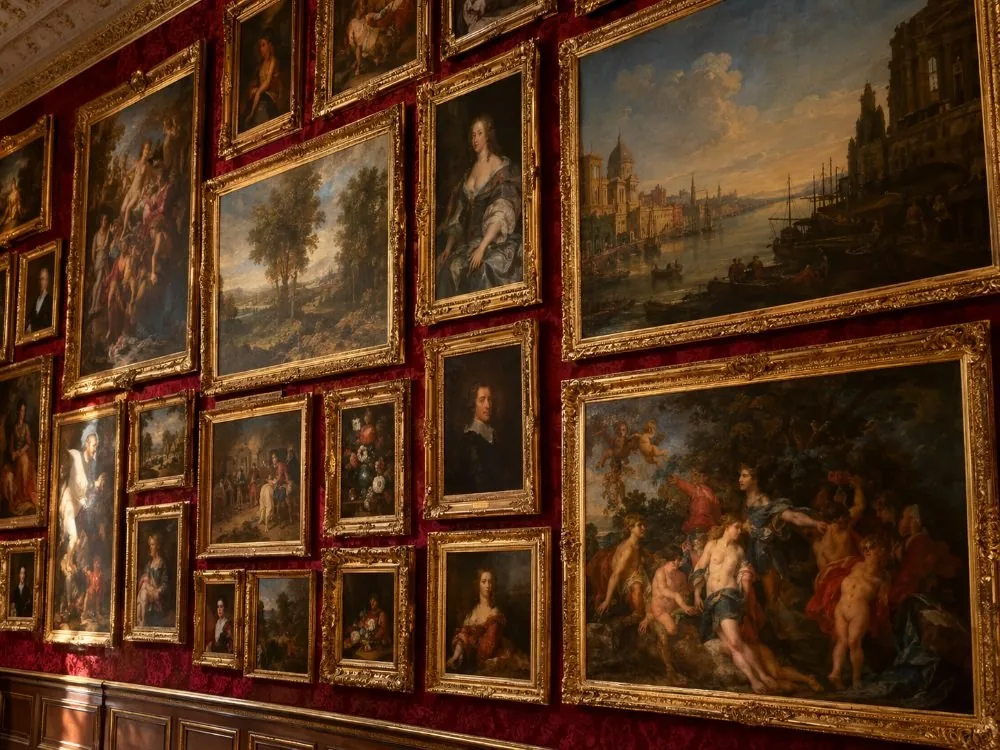
A modern museum hangs pictures in a line at eye level, one idea per wall, with a label under each. A private collection of the seventeenth and eighteenth centuries did the opposite: every inch of wall carried something, the big things went high, the pairs went either side of a door, and the point of a wall was that it balanced. Architect Francesco Nicoletti designed the arrangement that is still respected here, in the wings Gabriele Valvassori built between 1731 and 1734, and the family has kept it rather than modernising it.
You can see the logic most clearly in the Poussin Room, where the landscapes climb the wall almost to the ceiling and canvases by Guillaume Courtois sit right up at the top, where nobody can really look at them. That is not neglect. A picture up there was doing a job in a composition of pictures. Between 1678 and 1681 the family had even built dedicated rooms for particular kinds of subject — a room of pictures, a room of animals, a room of landscapes — which tells you how deliberate all of this was.
About the labels
Here I want to be exact, because this is a question people ask constantly and the internet answers it with more confidence than it has earned. No source I can find states affirmatively either that there are wall labels here or that there are none. What I can tell you is what the hang is and what the gallery provides: a historic arrangement of this kind carries little or no conventional museum labelling, and identification is done through the audio guide, which is the gallery’s primary interpretation tool and is included with admission. That is our reading of a historic hang rather than a published rule, and I would rather flag the difference than print a flat claim I cannot stand behind.
The practical consequence is the same either way. Collect the commentary at the desk on your way in, in Italian, English, French or Spanish, while supplies last. Without it you will have a lovely time and know almost nothing. What the commentary is and whose voice it is.
Look at one wall as a single object before you look at any picture on it. Find the axis, usually a door or a window, then notice what has been paired on either side of it and what was chosen to crown the group. Once you see the wall as the composition, the stacking stops feeling like clutter.
Why they never modernised it
Because it is theirs. This is a private collection in a private house, held since 2013 by the Doria Pamphilj Trust, whose stated purpose is to keep the heritage whole and to hold ownership and management together over time. Innocent X set the pattern as early as 1651, when he established the gallery through a fideicommissum designed to stop the collection being broken up. Keeping the 1767 arrangement is the same instinct, three centuries later. Who owns it.
There is a nice coincidence in the dates, too. The palazzo was renovated in 1767 for Andrea IV’s marriage to Princess Leopoldina Maria of Savoy, supervised by the same Nicoletti, with state-room ceilings frescoed by Crescenzio Onofri, Aureliano Milani and Stefano Pozzi. The inventory that still governs where the pictures go was written in the year the rooms around them were being redone. The building itself.
See it the way the inventory describes it
Reserved entry in a 30-minute window, 4.7 from 1,910 reviews, with the included commentary collected at the desk. On this route the commentary is not a luxury — it is how the pictures get their names back.
Frequently asked questions
Why are the paintings hung so close together at the Doria Pamphilj?
Because the gallery keeps the late eighteenth-century arrangement described in a manuscript of its own archive dated 1767: salon-style, floor to ceiling, grouped for symmetry and style rather than by school or date, in palace corridors rather than purpose-built rooms.
Are there labels next to the paintings?
No source states affirmatively that there are or that there are not. What is certain is that a historic hang of this kind carries little or no conventional labelling and that the gallery uses the included audio guide as its interpretation tool. Collect one at the desk — how that works.
Who designed the arrangement?
Francesco Nicoletti designed the eighteenth-century arrangement that is still respected, inside the four wings Gabriele Valvassori built between 1731 and 1734. The same Nicoletti supervised the 1767 renovation of the palazzo.
Does the hang make it hard to see the famous pictures?
Not the famous ones. The Velázquez has a cabinet to itself and the best-known works are hung where you can look at them; it is the third and fourth rows that are out of reach. What to stop at.